/Sheffield_Logo_Horizontal_Reversed.png)
Should You Finish Your Basement, Remodel—or Build Your Next Home?
At some point, almost every growing household reaches the same conclusion: We need more space.
Maybe the kids are getting older. Perhaps working from home has turned the dining room into an office. Maybe guests are sleeping on an air mattress. Or maybe the house that worked beautifully five or ten years ago simply doesn’t fit the way you live today.
The natural next thought is often: Do we need a bigger house? Perhaps. But before you start touring homes, calculating a new mortgage payment, or mentally packing boxes, there’s another place worth looking first: downstairs.
If you have an unfinished—or underused—basement, you may already own much of the additional space you’re looking for. That doesn’t mean finishing a basement is always the right answer. Sometimes a remodel makes more sense. And sometimes you really have outgrown your home, and the best next step is building something new.
First, Ask Yourself: What Do We Need More Of?
“More space” can mean many different things. Do you need another place for the family to gather? A private bedroom for guests? A quiet office? A home gym? More storage? A bathroom for teenagers? A space where kids can make noise without taking over the main level?
Or is your wish list bigger than that? Perhaps you want a larger kitchen, integrated indoor-outdoor living, a main-floor primary suite, expanded garage space, a different neighborhood, better views, or an entirely new architectural style. These are very different needs—and they point toward very different solutions.
Before deciding whether to finish, remodel, or move, start by writing down what isn’t working in your current home. Then separate that list into two categories:
-
Things more usable square footage could solve, and
-
Things that require a fundamentally different home.
Clarifying this distinction makes your decision much clearer.
Option 1: Finish the Basement
If you love your home, your neighborhood, your yard, and your location—but need more functional space—a finished basement may be the most logical place to start.
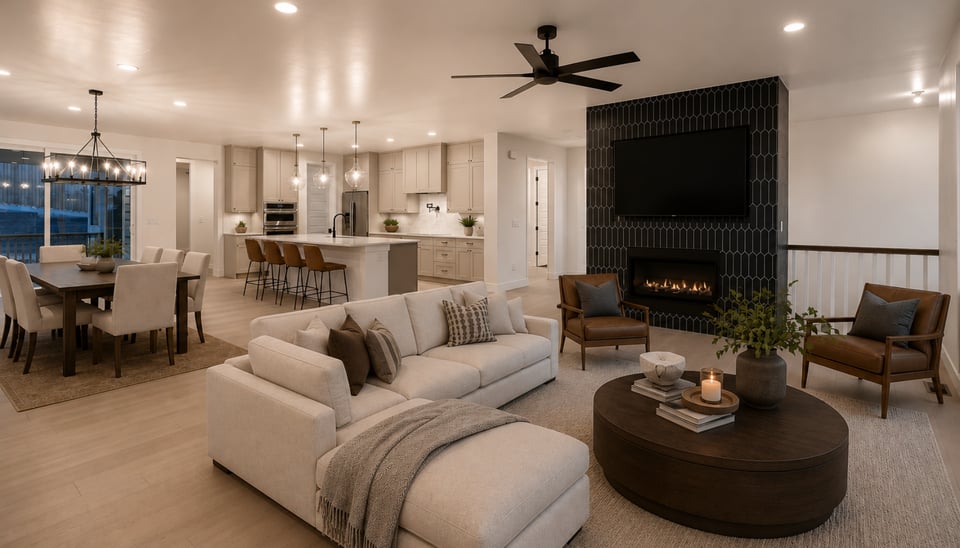
A well-designed lower level can become far more than a large recreation room. Depending on the home, it may include a family room, guest suite, bathroom, bar, fitness space, home office, playroom, theater, or flexible spaces that serve several purposes over time.
The best basement designs don’t feel like an afterthought; they feel like a natural extension of the home upstairs. That means considering ceiling details, lighting, flooring, cabinetry, millwork, built-ins, and finishes with the same care you would give the main level. It also means thinking beyond what your family needs today.
The playroom that works beautifully for young children might eventually become a teen hangout. The home office could someday become a guest bedroom. The open gathering area may serve movie nights now and holiday entertaining later. A thoughtfully designed basement gives you room to grow without changing your address.
Finishing Your Basement May Make Sense If:
- You already love where you live.
- Most of your frustration comes from not having enough usable rooms.
- Your basement has sufficient space and layout potential.
- You want to add functions such as a guest suite, family room, office, gym, or entertainment area.
- You would prefer to invest in your current home rather than take on the disruption of moving.
There is also something admittedly appealing about this idea: before buying more square footage somewhere else, make better use of the square footage you already own.
Option 2: Remodel the Home You Have
Perhaps you have plenty of square footage, but the home no longer functions the way you want it to. A closed-off kitchen might need to connect more naturally to living and entertaining spaces. The primary suite may need updating. The owner’s entry may be undersized, or the main level may feel dated compared with how your family lives now.
In those situations, remodeling can allow you to preserve the things you love about your home while changing the things you don’t. This route often makes the most sense when your location is difficult to replace. A desirable lot with mature landscaping, proximity to schools, mountain access, neighborhood relationships, and/or a view you love can all be compelling
A remodel asks a different question than a basement finish: Not “Where can we find more space?” But “How can the home we already love work better?”
Option 3: Build the Home That Comes Next
There is a point at which improving the current home begins to feel like trying to make it something it was never designed to be.
Perhaps you need considerably more square footage. Maybe you want main-level living for the long term. You need additional garage space. You want acreage, a different setting, better views or a home designed specifically around how you live now. At that point, finishing a basement may solve one problem while leaving five others untouched. That’s when it may be time to move up.
Building a new home allows you to think much more broadly—not simply about individual rooms, but about the way your home supports your life as a whole.
- How should the kitchen relate to outdoor spaces?
- Where should guests stay?
- What does the ideal home office look like?
- How much storage do you actually need?
- Where does everyone drop their gear when they walk through the door?
- How will your needs change over the next ten or twenty years?
These questions are difficult to address through piecemeal renovations. A new home lets you solve them together.
Building a New Home May Be the Better Fit If:
- Your current property cannot accommodate the layout or square footage you want.
- You want a different location, lot, or view.
- Main-floor living has become important.
- You need significant changes throughout the entire home.
- Your long-term wish list goes well beyond additional living space.
- You want a home designed specifically around your lifestyle, rather than adapting an existing floor plan.
.png?width=1500&height=400&name=splurge-save-skip%201%20(1).png)
Think About the Next Five Years—Not Just the Next Five Months
One of the easiest mistakes homeowners make is solving for the immediate frustration. The toys are everywhere, so you need a playroom. Guests are visiting, so you need another bedroom. You’re working from home, so you need an office. These needs matter. But before making a significant investment, think several years ahead.
Will teenagers need more independence? Will parents or adult children stay for longer visits? Could working arrangements change? Do you expect to entertain more? Are you approaching a stage when fewer stairs would be preferable? Are you likely to remain in the same neighborhood? A well-designed home should work beautifully for today—and adapt gracefully to what comes next.
That applies whether you are finishing 1,000 square feet downstairs or designing an entirely new home.
Consider the Cost of Disruption
The decision is not purely financial. Moving means preparing a house for sale, showings, packing, purchasing, financing, moving, and then settling somewhere new.
Remodeling means living through construction.
Building means making many decisions over a longer period—but it also creates the opportunity to make those decisions intentionally from the beginning.
There is no universally “easiest” option. There is only the option whose tradeoffs make the most sense for you, and that is why we believe homeowners should resist starting with the project. Start with the life you want the project to support.
So. . . Should You Go Down, or Move Up?
If you love your home but need it to do more, look downstairs first. If the square footage is sufficient but the layout no longer works, remodeling may unlock an entirely different experience within the home you already have. And if your needs have moved well beyond what your existing property can reasonably provide, it may be time to start imagining the home that comes next.
At Sheffield Homes, we have the unusual opportunity to see this decision from both sides. We create finished basements that transform unused lower levels into some of the most loved spaces in the house. And we build custom and luxury homes for people who have reached the point where their next chapter calls for something entirely new.
Our goal isn’t to convince you that one answer is always right; it’s to help you understand what’s possible. Sometimes the right move is unlocking the home you already have, and sometimes it’s creating the home you’ve outgrown it for.
Look Down Before You Move Up
Before you start looking for more square footage somewhere else, take a fresh look at the square footage you already own.
Imagine what your basement could become.
Think about what your current home can—and cannot—give you.
Then decide from there.
Considering a Finished Basement, a Larger Remodel, or Building a New Home in Colorado?
Let's talk about what makes the most sense for the way you want to live. At Sheffield Homes, we build around your priorities.